
The Ultimate Guide to Community Needs Assessments: Moving from Insight to Impact
By Alexandra Piatkowski
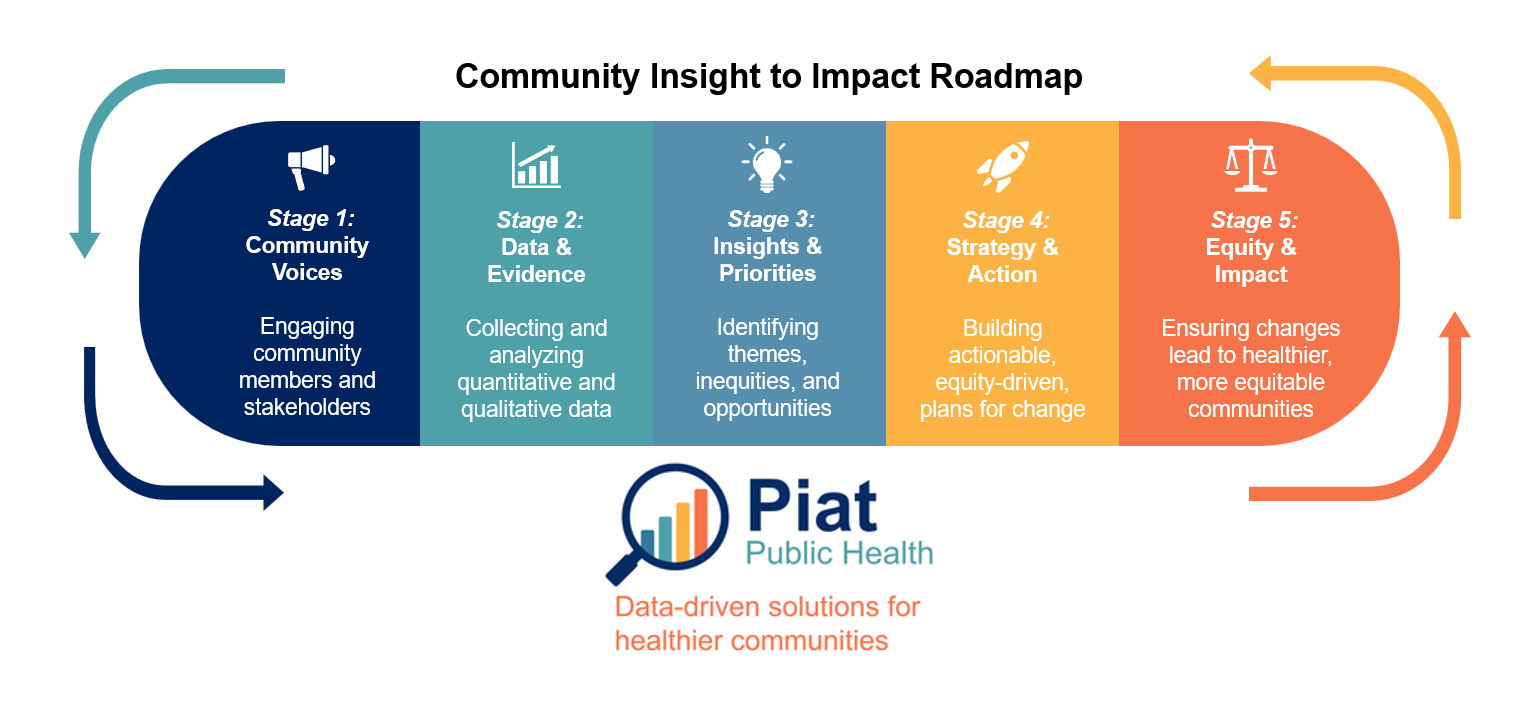
Piat Public Health’s Community Insight to Impact Roadmap
Community health needs assessments, community health assessments, population health assessments — there are many names for this important public health tool. But, whatever you may call them, they are the foundation of effective public health strategy. But too often, they rely solely on existing data sources — datasets that miss the very voices most impacted by inequities.
At Piat Public Health, we use our Insight to Impact Roadmap to help organizations move beyond “checking the box” to building actionable, equity-driven strategies. A mixed-methods needs assessment is one of the most powerful ways to do that.
Instead of focusing only on what disparities exist, mixed methods help uncover why they persist — and most importantly, how communities themselves envision solutions.
Here’s how to design an equity-centered, mixed-methods assessment using the five steps of the Insight to Impact Roadmap.
Stage 1: Community Voices
Engaging community members and stakeholders
Every assessment must start with people, not just numbers. Focus groups, listening sessions, key informant interviews, surveys and more elevate the voices of those most affected by inequities — people whose experiences are often invisible in administrative datasets. Building safe, inclusive spaces for dialogue ensures the assessment reflects community priorities, not just institutional agendas.

Focus groups, listening sessions, key informant interviews, surveys are just some of the ways to integrate community voices into your assessment.
Stage 2: Data & Evidence
Collecting and analyzing quantitative and qualitative data
Mixed methods means pairing the breadth of quantitative data with the depth of qualitative insights. Administrative datasets show where disparities exist, but qualitative methods explain why they persist. By disaggregating data (race, income, geography, etc.) and intentionally oversampling underrepresented populations, you create a fuller, more accurate picture of health needs.
Stage 3: Insights & Priorities
Identifying themes, inequities, and opportunities
Once community voices and data are collected, the next step is weaving them together. Using tools like concept mapping or facilitated dialogue, stakeholders can identify shared priorities. This stage ensures strategies are not just evidence-based, but also equity-driven — reflecting both statistical patterns and community wisdom.

Ensuring stakeholder and community buy-in to priorities is crucial to a meaningful assessment.
Stage 4: Strategy & Action
Building actionable, equity-driven plans for change
The biggest mistake organizations make is stopping at the report. At this stage, the findings must be translated into clear, practical strategies (these may be Community Health Improvement Plans, Implementation Strategies, or other strategic plans). That means creating products for multiple audiences — from community-friendly summaries to technical briefs — and ensuring recommendations are feasible, measurable, and tied to equity goals.
Stage 5: Equity & Impact
Ensuring changes lead to healthier, more equitable communities
The real test of a mixed-methods needs assessment is not the data collected, but the impact created. Establish feedback loops so communities see how their input shaped decisions. Track progress on reducing disparities using an evaluation framework. And, most importantly, sustain engagement so communities remain partners long after the assessment ends.

The best community partnerships are those that are ongoing and reciprocal.
Final Reflection
Mixed-methods needs assessments take time and investment, but they transform what could be a compliance exercise into a catalyst for change.
That’s the heart of the Insight to Impact Roadmap: moving from data and stories → to insights → to action → to measurable improvements in equity.
If your organization is ready to strengthen its approach, Piat Public Health is here to help. Together, we can build assessments that don’t just describe community health — they change it. Contact us today to get started.
