
Digital Health in 2026: The Real Innovation is Making Technology Work for People
By Alexandra Piatkowski

2026 Future of Health, Leadership, Informatics, and Policy (FHLIP) Conference
Recently, I attended the FHLIP 2026 Conference at the University of Toronto’s Institute of Health Policy, Management and Evaluation (IHPME). The theme — “From Silos to Synergy: Building Bridges” — couldn’t have been more timely.
The conversations reinforced something I’ve believed for a long time:
Technology itself isn’t the innovation.
The real innovation is making sure it actually improves care — for clinicians, patients, and the systems that support them.
Because while I’ve worked at the intersection of public health, healthcare systems, and digital health for years...
I don’t build technology.
I help make sure it works for the people who matter.
Technology Alone Doesn’t Transform Systems
Earlier in my career, I worked with Amplify Care, evaluating the adoption of digital health tools such as electronic medical/health records, virtual care, eConsult, eReferral, and more.
One lesson became clear very quickly:
Technology alone doesn’t transform healthcare.
Real change happens in the messy middle — where digital tools meet clinical workflow, policy, culture, and human behaviour. Without thoughtful implementation, even the best tools struggle to create meaningful impact.
That’s why so much of my work focuses on implementation, evaluation, and engagement.

FHLIP Friends: Alexandra Piatkowski, Jonathon Loudon, Norman Young, and Martin Droruga
Digitizing Broken Systems Doesn’t Fix Them
A strong theme at FHLIP was something many of us have seen firsthand:
We’ve spent the last decade digitizing processes instead of redesigning them.
Turning a confusing paper process into a digital one doesn’t automatically make it better. In some cases, it makes systems harder to navigate — especially for people already facing barriers like language, digital literacy, or access.
True innovation requires redesigning care pathways first, then using technology to support them.
Otherwise, we risk scaling inefficiency — and inequity.
AI Must Solve Real Problems (and Be Implemented Responsibly)
AI was everywhere at FHLIP — but the conversation has matured. It’s no longer about what AI can do, but what it actually solves.
Tools like AI scribes are gaining traction because they address a real pain point: clinician documentation burden. Reducing that load creates more time and capacity for patient care.
Through my work with partners like Alifor Clinical Decision Support and Cloud9, I’m seeing this play out in real time.
Alifor is focused on embedding AI into clinical workflows — supporting documentation, decision-making, and coordination of care. Cloud9 is tackling another critical layer: enabling privacy-preserving data infrastructure so that information can be used responsibly across systems.
In both cases, the opportunity isn’t just the technology itself — it’s how it’s implemented.
We’re currently working on testing and running pilot projects across different healthcare settings and jurisdictions to understand where these tools actually deliver value and how.
Because adoption is outpacing system readiness.
Without strong governance, evaluation, and attention to bias, even well-intentioned AI can reinforce existing inequities.

We are excited to announce our partnership with Alifor!
Interoperability Still Matters
Despite years of progress, interoperability remains one of the biggest barriers in digital health.
We have more data than ever — but it often doesn’t move between systems.
For patients, especially those with complex needs, this creates a coordination burden. They are left to carry information between providers, repeat their story, and navigate disconnected services.
If digital health is going to work, data needs to follow the patient — not stay trapped within institutions.
Making Technology Work — From Innovation to Impact
At Piat Public Health, our work sits at the intersection of innovation and implementation — grounding digital health initiatives in real-world systems through clinician engagement, community input, and rigorous evaluation.
Because the future of digital health isn’t about having more technology. It’s about making sure the technology we build actually improves care — for clinicians, patients, and the systems that support them.
If we want digital health — including AI — to truly transform care, we need to move beyond adoption and focus on impact.
That means advancing the Quintuple Aim:
Better patient experience
Improved population health
Lower costs and improved workflow efficiency
Better clinican experience and reduced burnout
Equitable care and outcomes for all
If you're working on digital health or AI and want to ensure it delivers real, measurable impact — not just implementation — let’s connect.
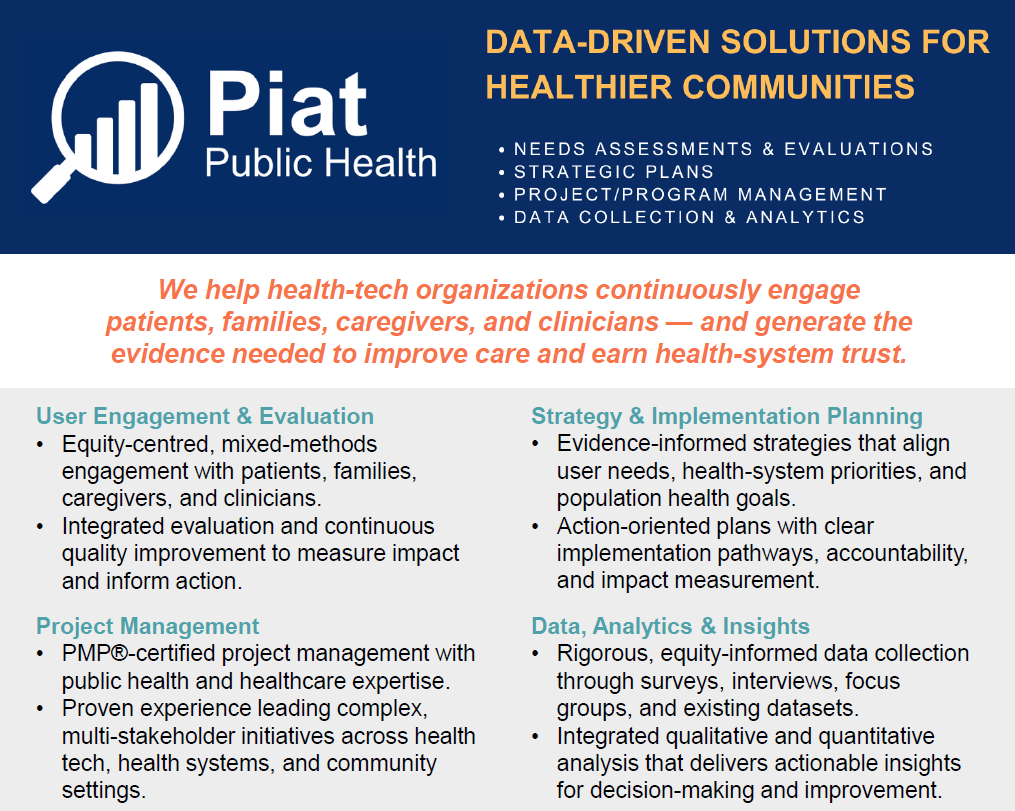
How Piat Public Health supports health tech
