
Project Management in Public Health & Healthcare: Why It Looks Different in the Real World
By Alexandra Piatkowski

Photo Credit: Heather Shannon Photography
Project management can sound cold.
Timelines. Milestones. Deliverables. Risk logs.
It doesn’t exactly evoke warmth or humanity.
But after years working in public health and healthcare — I’ve come to believe the opposite:
Project management is one of the most people-oriented roles out there.
The Textbook vs. The Real World
In theory, project management is linear. You define scope, sequence tasks, assign roles, and monitor progress.
In public health and healthcare, it rarely unfolds that way.
Because you’re not just managing tasks — you’re navigating:
Clinicians and professionals with competing demands
Leaders balancing system pressures
Community partners with limited capacity
Patients, caregivers, families, and community members whose lived experience must shape the work
Data that doesn’t always tell the full story
Priorities that shift in real time
There are so many moving parts. So many stakeholders. So many human dynamics.
And that’s exactly why strong project leadership matters.
In this environment, project management isn’t about enforcing a plan. It’s about creating clarity in complexity. It’s about alignment, trust, accountability, and momentum.
It’s about helping smart, overextended people move in the same direction without burning out.
What Project Management Really Looks Like in Public Health
In healthcare and public health, projects sit inside living systems.
Emergency departments don’t pause for implementation. Community partners don’t suddenly gain capacity. Policy and funding landscapes don’t stay stable.
So the role becomes:
Clarifying governance so decisions don’t stall
Defining roles so teams aren’t duplicating effort
Managing scope while protecting the vision
Anticipating risks before they derail progress
Translating strategy into actionable steps
Holding space for shifting realities without losing momentum
Funding considerations
It requires structure and adaptability at the same time.
It requires technical rigour and emotional intelligence.
And it requires keeping people — not just process — at the centre.
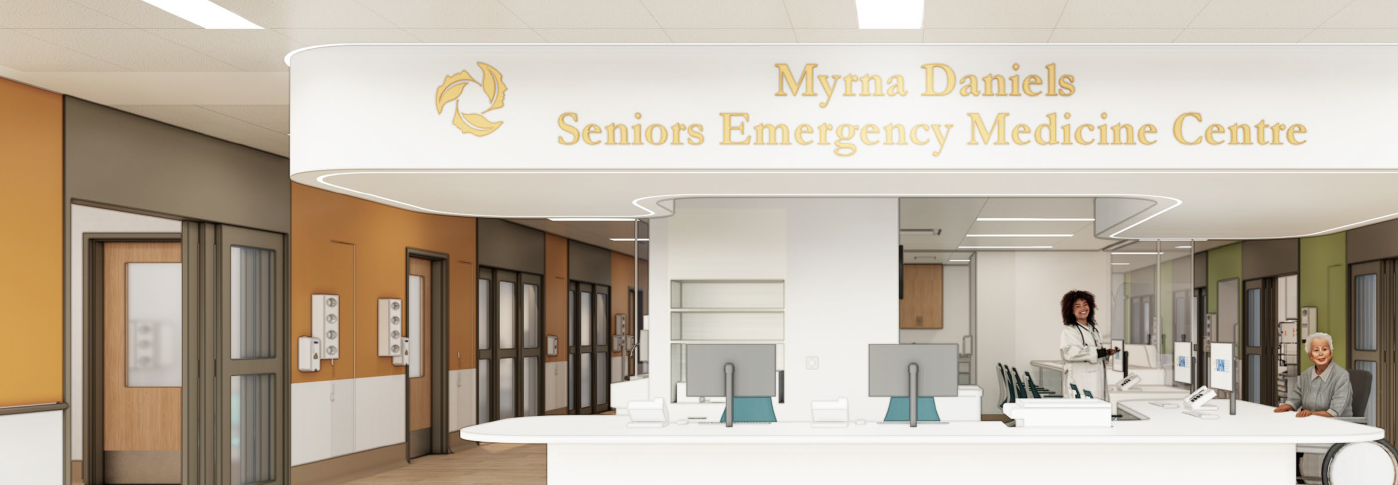
Source: Canadian Centre for Healthcare Facilities, 2023
Case Study: Seniors Emergency Care Project
One of the most defining examples of this in my career was when I co-led the development of the Seniors Emergency Medicine initiative at University Health Network.
This work ultimately contributed to the establishment of the Myrna Daniels Seniors Emergency Medicine Centre — supported by a historic $52 million philanthropic investment and designed to transform emergency care for older adults — generously made by the John and Myrna Daniels Foundation.
But long before there was a public announcement, there was complex groundwork.
I co-led the development of the strategic framework and proposal — coordinating across emergency medicine leadership, geriatric specialists, operations teams, researchers, and foundation stakeholders to build a cohesive, fundable, and operationally sound model.
This wasn’t simply drafting a proposal.
It meant:
Synthesizing diverse clinical perspectives into a unified model of care
Designing governance and accountability structures
Mapping phased implementation plans
Defining measurable outcomes and evaluation strategies
Anticipating operational risks in high-pressure emergency settings
Ensuring the initiative extended beyond physical space into true systems redesign
The goal was ambitious: redesign emergency care to better meet the needs of older adults — from designing a dedicated space to interdisciplinary geriatric workflows to stronger transitions back into community care to cutting-edge research and education.
To get there required alignment across:
Physicians, nurses, and allied health professionals
Senior, patient, caregiver, and family partners
Hospital executives, capital planning, and finance teams
Research and education leaders
Community partners
Philanthropic partners
Government stakeholders
There were competing priorities. Capacity constraints. Clinical pressures.
The only way forward was disciplined, people-centred project leadership. And remembering our why — better care and outcomes for seniors.

Photo Credit: Heather Shannon Photography
Why This Work Changed How I See Project Management
Leading this initiative reinforced something I’ve come to deeply believe:
Project management in public health and healthcare is strategic leadership.
It is not administrative oversight. It is not task tracking.
It is:
Creating shared direction in complex systems
Protecting momentum when pressures compete
Translating big vision into operational reality
Ensuring bold ideas don’t fall apart in implementation
Older adults entering emergency care don’t experience “a project.” They experience vulnerability.
And behind every public health and healthcare initiative are real people whose lives are affected by whether the work is implemented well.
Structure + Humanity
As an epidemiologist and Project Management Professional (PMP®), I rely on structured tools — workplans, risk logs, RACI matrices, milestone tracking.
But those tools are there to serve people.
Because rigid plans fail in dynamic systems. And unstructured passion fails under operational pressure.
The balance is structure + humanity.
That’s why project management in public health and healthcare looks different.
It’s relational. It’s adaptive. It’s strategic. It’s deeply human.
And when done well, it is one of the most powerful levers we have to move from vision to impact.
Ready to move your project forward?
If you’re leading a complex public health or healthcare initiative and need structured, people-centred project leadership, Piat Public Health can help.
📩 Get in touch to learn more about our project and program management services.
