
Dementia Can't Wait: Why We Need to Stop Fighting Silent Battles
By Alexandra Piatkowski
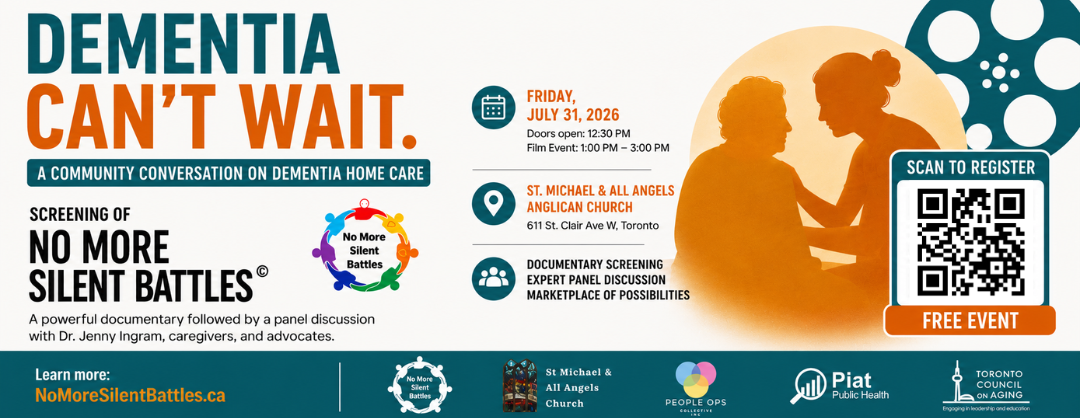
On Friday, July 31, I'll have the privilege of moderating a community conversation that I believe couldn't be more important.
I'm honoured to be joining Dr. Jenny Ingram, Lydia Ireland, and Sharon Chapman-Sheehan for No More Silent Battles: Film Screening & Community Conversation on Dementia, an event that brings together healthcare professionals, caregivers, advocates, community organizations, and people with lived experience to have an honest conversation about one of the greatest public health challenges of our time.
The documentary follows four families navigating the realities of dementia and the often overwhelming journey through our health and social care systems. It highlights the emotional, practical, and financial realities of living with dementia while calling for meaningful reforms that help people remain at home, support family caregivers, and strengthen communities.
This event feels deeply personal to me because it brings together so many aspects of the work I've dedicated my career to—from improving care for older adults to ensuring community voices shape the decisions that affect them.
Dementia Is One of the Greatest Public Health Challenges We Face
As our population ages, dementia is affecting more families than ever before.
Yet despite how common it is, many people still experience dementia in silence.
Families often struggle to find information after a diagnosis. Caregivers become overwhelmed trying to coordinate appointments, navigate fragmented services, balance work and caregiving responsibilities, and advocate for the support their loved one needs. People living with dementia frequently encounter stigma, isolation, and systems that simply weren't designed around their needs.
This isn't just a healthcare issue.
It's a public health issue.
It's a caregiver issue.
It's a community issue.
And ultimately, it's an issue that touches all of us.
What I Learned Working in Seniors Care
Long before founding Piat Public Health, I had the privilege of co-leading the development of the Seniors Emergency Medicine Centre at University Health Network, Canada's first accredited geriatric emergency department.
While our work focused on improving care within hospitals, one lesson became incredibly clear: many of the crises bringing older adults to the emergency department didn't begin there.
Often, they started months—or even years—earlier.
A caregiver who had reached exhaustion.
A dementia diagnosis without adequate follow-up support.
Difficulty accessing home care.
Challenges navigating an increasingly complex health and social care system.
Families weren't failing the system.
The system was often failing them.
Hospital care will always be important, but we cannot build healthier communities by focusing only on what happens inside hospital walls. We also need strong home care, community supports, caregiver resources, coordinated services, and policies that allow people to age with dignity where they want to be—in their homes and communities whenever possible.
Listening Before Leading
That philosophy continues to guide the work we do every day at Piat Public Health.
Over the past several months, our team has been leading community engagement with seniors and caregivers across York Region, facilitating focus groups and conversations about how extreme heat affects older adults.
Although the topic is different, many of the themes have been remarkably familiar.
We've heard about caregivers juggling countless responsibilities.
We've heard about loneliness and social isolation.
We've heard about transportation barriers, housing concerns, financial pressures, and the challenge of navigating services that often feel disconnected from one another.
Most importantly, we've heard incredible ideas from people who know exactly what needs to change because they live these experiences every day.
Every focus group reminds me why meaningful engagement matters.
The people closest to the challenges are often the people closest to the solutions.
Data Matters. Stories Matter More.
As an epidemiologist, I spend much of my career working with data.
I love data.
It helps us identify trends, understand inequities, evaluate programs, and make evidence-informed decisions.
But "traditional" data only tells part of the story.
Stories provide the context.
Stories create empathy.
Stories help us understand what numbers alone never can. And stories are data themselves.
That's why I believe storytelling is one of the most powerful tools we have in public health.
When we centre lived experience alongside research and evidence, we create policies and programs that are not only effective—but truly responsive to the people they're intended to serve.
Too often, community engagement becomes a checkbox exercise.
Organizations hold consultations.
Reports get written.
Recommendations are made.
Then the people who shared their stories never hear what happened next.
At Piat Public Health, we believe engagement should be the beginning of change—not the end of a project.
Why No More Silent Battles Matters
Last month, I had the privilege of moderating a virtual screening and discussion of No More Silent Battles.
The conversation was powerful.
People shared their own experiences with dementia, caregiving, grief, resilience, and hope. It reinforced something I've seen throughout my career: people want spaces where these conversations can happen openly and honestly.
That's why I'm so excited that we're continuing the conversation in person on July 31.
In addition to the documentary and panel discussion, attendees will have the opportunity to explore a Marketplace of Possibilities, connecting directly with organizations, services, and resources that support older adults and caregivers.
Because awareness is important.
But connecting people to support is even more important.
I'm also incredibly proud that this event reflects what collaboration can look like when organizations come together around a shared purpose.
It brings together No More Silent Battles, Piat Public Health, People Ops Collective, the Toronto Council on Aging, and St. Michael and All Angels Anglican Church—partners from healthcare, public health, advocacy, and the community who recognize that dementia cannot be solved by any one organization alone.
Keeping People With Lived Experience at the Centre
One of the things I admire most about this initiative is that it doesn't just talk about dementia.
It amplifies the voices of people living it.
Whether it's through film, community conversations, caregiver perspectives, or advocacy, the initiative recognizes something that should guide all public health and healthcare work:
Nothing about people without people.
People living with dementia.
Family caregivers.
Older adults.
Frontline care providers.
Their experiences should never be an afterthought.
They should be the foundation upon which better systems are built.
Whether You're in Toronto or Anywhere Else, You Can Help
If you're in Toronto, I hope you'll join us on Friday, July 31 for this important conversation.
But even if you can't attend—or if you're reading this from another community—you can still make a difference.
You can:
Learn more about dementia and the realities families face.
Listen to the caregivers in your own life.
Share the No More Silent Battles advocacy campaign.
Advocate for stronger home care, caregiver supports, and age-friendly communities.
Bring conversations like this to your workplace, municipality, healthcare organization, or community group.
Real change begins when more people understand that dementia isn't someone else's issue.
It's all of ours.
Building Communities Where People Can Age with Dignity
As Chair of the Toronto Council on Aging and through the work we do at Piat Public Health, I remain optimistic.
Every conversation with older adults.
Every focus group.
Every caregiver story.
Every community partnership.
They remind me that there are incredible people working every day to build a future where older adults are supported, caregivers are valued, and people living with dementia can thrive with dignity.
That future starts by listening.
It starts by centring lived experience.
And it starts by refusing to let these stories remain silent.
I hope you'll join us—whether in person, through the advocacy campaign, or simply by continuing the conversation in your own community.
Because dementia can't wait.
And neither can we.
